Showing posts with label nyc. Show all posts

Sunday, March 26, 2017

Vinyl

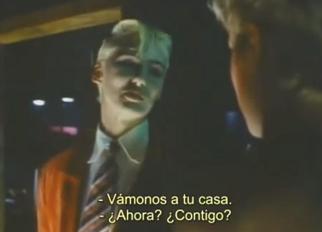
I know what you're thinking: But Andy Warhol movies are lame and tedious. And, admittedly, most are. But Vinyl is definitely the most watchable. Not coincidentally, it was also the film that introduced Edie Sedgwick, the closest thing to an actual movie star in his gang of "superstars."


Ostensibly a NYC hipster version of A Clockwork Orange, Vinyl is sort of a vague lo-fi exploration of S&M, homoeroticism and go-go dancing. Lots and lots of go-go dancing. Mostly to the Kinks and the Vandellas. The Anthony Burgess plot and the world he created are pretty much dropped for a single set--hell, a single shot--of a few people in a basement shouting random phrases in each other's direction. In this respect, it is like many Warhol films.


Gerard Malanga is the ostensible star of Vinyl, the delinquent who breaks the law (all the laws) and must be forcibly reformed. He spends a lot of time posing and dancing and occasionally lifts weights or shoves someone around. As far as what passes for acting, he holds forth in the usual Warhol manner, i.e. a vague gesture at 40s-50s B-movie style. Sure, he would fit in pretty well in the background of Motorcycle Gang or Dragstrip Riot, but his stilted line readings would likely prevent him from doing much more. (Stop trying to make "scum baby" happen, Heather!)


Edie says nothing, but she's the center of attention thanks to sheer star quality... okay, and a little help from screen position. However, she gives a clinic in how to be present in--and even dominate--a scene without technically doing or saying anything by absorbing everything, reacting to everything. (When i recently made a brief and weird return to the stage, i had a good 10 minutes of  "nothing" at one point, and Edie in Vinyl was inspiration for how to handle it. Also Marlene Dietrich in anything.) In a room full of people giving attitude, presenting themselves in this pose or that stance, she just is.


Eventually, Malanga gets ranted at by the cop and worked over the the sadists and everyone drinks plastic-cup cocktails and chainsmokes while someone plays records in the background. And that's part of what makes Vinyl interesting: There are always several things going on at once--if the foreground monologue bores you, there's always the background dancing, or someone getting fucked with or fucked up over on the side or whatever Edie is doing.


Intermittently, they give up on the dialogue and Malanga frugs frantically in his tight white hustler jeans as the  "cop" leans back in his office chair and leers. Sedgwick sways back and forth, weaving one eloquent arm. In the background, another guy in white jeans roughs up a shirtless man in a gimp mask while two other men watch dispassionately. As everyone drifts off into their own little bubble of vice and bliss, it's like the after-hours of countless drug-dipped downtown Manhattan parties.


Along with being a fine illustration of what Andy Warhol's famed Factory must have been like on a good night, Vinyl is a record of that weird 60s moment halfway between beatnik and hippie. Today when people talk about "underground," it's just another buzzword for your Facebook/Tinder/marketing profile. (No one knows what "poseur" or "sellout" mean either.) but Vinyl is a relic of a time when the edge really was a place that few people saw and even fewer actually went.


Wednesday, October 28, 2015

The Seventh Victim

Screw your torture porn: Give me the slowly building menace of a Val Lewton horror every time.
 The Seventh Victim is part of the series of darkly brilliant films Lewton produced for RKO. One would ask why a film now seen as a classic by a revered writer/producer would qualify as craptacular, but bear in mind that RKO was considered a bit of a second-class studio and this was horror back in an era where the genre was second-class by definition.
The Seventh Victim initially may seem like a conventional whodunnit--well, more accurately, a whereisshe--but it's got a deep streak of nihilism and a sense of doom hangs over it from the start, and not just because it opens with a trip to the principal's office. Our heroine, Mary, is summoned by the Head Dyke in Charge at her boarding school to be told that her tuition hasn't been paid and her older sister is missing. HDIC offers to let her stay on and work for her room and board but, as she leaves, HDIC's timid femme companion warns her: "Don't come back. No matter if you never find your sister. No matter what happens to you."
Mary makes her way to New York City and begins searching for her sister. She goes to the missing persons office of existential despair, where she runs across a rather weasely private eye type. 
She goes to the cosmetics company/spa that her sister owned to find that it's apparently been sold. The new Head  Dyke in Charge claims to have no idea where her sister is--but, as we saw back at school, behind every HDIC is a timid little femme who's willing to provide some information...
In a small Italian restaurant on Perry Street (the likes of which have been completely gentrified out of New York) she meets the couple who own the restaurant and who knew her sister , as well as writer's block-ed poet Jason. The latter joins in her search, the former spend a lot of time pouring wine and espresso and saying vague and wise things. (Definitely more useful in times of crisis.)
Mary also runs across Gregory, her sister's lawyer... and husband. She also makes the acquaintance of Jacqueline's psychiatrist, Dr. Louis Judd, who is played by Tom Conway. If Tom Conway seems like an ersatz George Sanders, it's because he's Sanders' younger brother. Dr. Judd has the same name and a similar demeanor as the psychiatrist in Lewton's Cat People--although Judd dies in Cat People, so we must assume that The Seventh Victim happens earlier in the Lewtonverse.
 
Another thing that happens often in the Lewtonverse is the "night walk," in which a character walks alone through darkened streets as suspense mounts and several false surprises are launched before the final, actual shock. We get several of them in The Seventh Victim, as Mary and Jacqueline each take their tense nocturnal stroll through the city.
 
Another constant from the Lewtonverse is the presence of Elizabeth Russell, who also appeared in Lewton's Cat People, Curse of the Cat People and Bedlam. Here she plays Mimi, a neighbor who is doing the slow fade from consumption.
Mary's search for her sister is mostly your classic hero's journey, recast as a noir film about a teenage girl's coming of age with a side dish of supernatural horror. Mary ventures into the big city, meets various allies and opponents, thinks of turning back but instead adapts to her new surroundings and plunges forward. She's played by Kim Hunter, who would earn an Academy Award as Stella in A Streetcar Named Desire and later play Zira in Planet of the Apes.
 
After some night walks and much fussing amongst the gentlemen, we discover that the "exciting and unforgettable" Jacqueline had fallen in with a group called the Palladists. Has she disappeared, or is she just hiding? And if she's hiding, where? And from who?
Jacqueline, with her black bangs, black fur coat and eternal pessimism--"I've always wanted to die"--is goth as all get out and clearly the coolest chick in the film. She's a bit like a cynical, death-bent Blanche DuBois wearing Bettie Page's hair and Louise Brooks' perfume. She is played by Jean Brooks aka Jeanne Kelly aka Ruby Kelly aka Robina Duarte--she changed stage names a lot after being discovered by Erich Von Stroheim while she was singing in the lounge at the Waldorf-Astoria. She made another Val Lewton film, The Leopard Man, but mostly worked in westerns and horror flicks, eventually dying of complications from alcoholism at 47.
But back to the film! It seems that "Palladist" is just a schmancy word for devil-worshipper. However, this group of Satanists isn't sacrificing babies or tormenting peasants or unleashing hordes of maggots--they're a pretty ordinary-seeming bunch, but their normalcy makes them even more chilling. Because it never is the fire-breathing horned monster that gets you: It's being ground down by the incessant nagging, the peer pressure, the adherence to nonsensical rules...
So much more enigmatic and chic than that silly pentagram-goat's head thing....

Like any fine art film, nightclub or romance, The Seventh Victim is all atmosphere and philosophy. It is said that when a RKO exec chided Val Lewton about films with messages, Lewton responded, "Our film does have a message and the message is: Death is good!"

Like all of Lewton's films, The Seventh Victim was under-appreciated in its time, but has since grown in influence and prestige: There are echoes this film in Psycho, Rosemary's Baby and numerous lesser flicks. It's not horror in the maniacs with machetes sense, but its eerie atmosphere and gloomy outlook will haunt you long after the credits have rolled.

Saturday, July 4, 2015

Three the Hard Way

Can I get a "Hell, yeah!" or, at the very least, a "What! What!"
Three the Hard Way is a blaxploitation flick directed by Gordon Parks, Jr. of Super Fly fame and starring legendary football player Jim Brown, football player of some repute and grindhouse hero Fred Williamson and martial arts star Jim Kelly, whom you probably know from Enter the Dragon. They're fighting  Nazis.

It seems a group of business-suited white supremacists have somehow created a poison (unlike today's business-suited white supremacists, they actually believe in science) that will kill only the black residents of Los Angeles, Detroit and Washington, D.C. Jim Brown's buddy finds out about this, they kill buddy and kidnap Jim's girl. So it's time to go out and get some payback. And save a few million people, of course. Give back to the community...

It was seeing shit like this that made the NRA and Ronald Regan
support gun control back in the 60s.

Along with plenty of righteous 70s threads, Brown shows off the tremendous physical grace--vaulting over barricades, leaping down stairwells, hanging on to the hoods of cars--that helped him lead the NFL in rushing for eight seasons (Although note that the suit is worn with a nice pair of kicks--which i am guessing are Pumas or Keds--because no one could do this in a pair of alligator Ferragamos.) Three the Hard Way does not stint on prolonged action scenes and isn't that why we're all here anyway?

 Although the fact that two of those action sequences involve wrecking a herd of sweet Detroit-made sedans and pumping hundreds of bullets into a collection of vintage pinball games does make a me a little sad. The latter takes places once Jim  Brown travels to New York City to get the first member of his posse: Fred Williamson. Fred Williamson is, as always, one smooth badass who always seems to be having a good time in his flicks, even crap like 1990: The Bronx Warriors and he seems to be enjoying Three the Hard Way even more than usual.
 
Then we come across Jim Kelly, or at least his bitchin' Lincoln  Continental having drugs planted in it by a herd of crooked cops. But with a mighty yell of  "Gonna set me up?!" he kicks the crap out of them.


It's a bit like a drawn-out version of a similar skirmish in Enter the Dragon; the next sequence will also reference the climactic car wash battle in Black Belt Jones. Our heroes manage to capture one of the Nazis and figure he ought to be good for some information...


We then get a glorious montage of a red-white-blue clad trio of biker babes coming into Manhattan from Brooklyn. The ladies are Countess, Princess and Empress (the last of whom is played by Irene Tsu of Ebony, Ivory and Jade, so she's rolled like this before). And, well, the ladies handle interrogations in a way that gives pause to even this rather rugged set of gentlemen. (If you want true brutality, call upon the women.)
More fistfights, more car chases, more running around shooting. It occurs to me that we never learn how these guys know each other or how they all became such profound ass-kickers. Usually they at least throw in a line about being Green Berets in 'Nam or, in this case, ex-football players. (Even Kelly, though he didn't go pro--he was also apparently a hell of a tennis player, though i somehow sense he must've had some hoop game as well.) We see Jim Brown as a producer (of the Impressions), but no idea what the other two guys do.
This band of nutjob cartoon white supremacists lacks the over-the-top misanthropic lunacy of a Donald Trump or Sarah Palin or Mike Huckabee, any of whom would be a far more ridiculous villain than Three the Hard Way's unctuous businessman. The Nazis of Three the Hard Way aren't really your classic movie Nazis: Their hair touches their collars and they are listening to music with acoustic guitars and synthesizers which, as we all know, is mixing the races. Their Nazi banquet is totally dorky--no The Damned or The Night Porter decadence here.


It's pretty obvious that our trio of heroes certainly possess physical, intellectual and sartorial superiority  over these schlubs in berets. (A beret only works if you're a chick doing some kind of Bonnie Parker/Patty Hearst or a guy with good hair and cheekbones that could cut diamonds who is somehow affiliated with MI6.)

The climactic attack on the Nazi mansion has that peculiar day-for-night mix where you keep wondering if the battle took three days or we're on an alternate Earth where the days and nights are 15 minutes long. Still, busting up Nazis in a flawlessly spherical 'fro and black leather pants, Jim Kelly comes off like a cross between Dr. J., Bruce Lee and Iggy Pop. Can you imagine anything cooler? Jim Brown shows off his superior skill at kicking down doors and leaping across furniture while firing a shotgun. Fred Williamson lays waste to many bad guys without taking the grin off of his face or the cigar out of his mouth.


One can fantasize that Eric Garner had been endowed with the cop-clobbering powers of Jim Kelly. Or that right at the moment Dylan Roof raises that gun in the Emanuel Church, Jim Brown busts through a stained-glass window, slides down the aisle and shotguns the little cracker with the Moe Howard haircut. A superhero ass-kicking wasted on a redshirt weasel, but still... 

... anyway, Three the Hard Way could do with a little more plot, but it's still pretty damn gratifying.

Sunday, May 31, 2015

Liquid Sky

When I was in high school, this movie put the zap on my head but good.
Ah, yes, New York City in the 80s. The downtown Scene of Liquid Sky, with its strangely unmelodic music, unwearable outfits and motionless dancing does indeed seem like Bohemia as imagined by an alien or emigre (or a suburban teen). And, of course, there's models, neon, Eurotrash, drugs, parties, fashion, philosophy, soap opera actors, performance art and multiple wardrobe changes. And, yeah, aliens.

 
"Delicious, delicious, oh, how boring."

So, our heroine is Margaret, is the classic pretty girl from a good suburban family who has turned into into a warpainted, substance-huffing scenster fashionista/victim. Or, as her girlfriend, Adrian the midget performance artist calls her, "an uptight WASP cunt from Connecticut." Margaret has no comment on being called this. Margaret has no comment on anything: She hasn't given a fuck in so long she's forgotten what giving a fuck even feels like.
 The ladies reside in a neon-bedecked apartment with a view of the Empire State Building. Back when you could afford that sort of thing on a petty drug dealer's salary. Now you'd have to be a real lowlife criminal to pay that kind of rent. Like a stockbroker or something.
 

We also meet some of the rest of our cast, classic New York characters all. The junkie artist who talks about Cocteau while he shoots up and sponges off of his girlfriend. The trust fund brat aka that "guy on the dance floor who's offering all the chicks cocaine." The professor who uses pretentiousness as both lure and repellant. The woman who has seen every scam and still falls in blind love with her eyes open. The nasty fashionista who says shit like "Frankly, this bird-of-paradise routine is done every day in Vegas--and better." The slumming Upper East Side matron who is tolerated for her wallet. The drug-huffing ambiguously gendered pretty boy...

Douse his hair in Clairol blue-black #124 and he's about half the guys i dated in my twenties. And, well, if it was an actual male, of course. For the hook here is that Anne Carlisle plays both Margaret and her nemesis, Jimmy, the male model.
Carlisle is slightly reminiscent of a wooden Tilda Swinton. After this, she went on to flounce through a bit as a transsexual in Crocodile Dundee and a five-minute guest spot on Miami Vice as a stewardess girlfriend of Don Johnson who dies when one of the coke-filled-condoms she's drug-muling ruptures. And a rather odd Liquid Sky-themed Playboy shoot.
So the upshot is that aliens land on the roof of Margaret and Lesbian Midget Performance Artist's apartment. Somehow the aliens feed off of some chemical produced in people's brains when they have orgasms (or get high). Now, consider that Margaret is frigid, but everyone wants to bang her. You can see the passive-very aggressive direction this is going...
Aside from the fiercest warpaint since Ladies and Gentlemen: The Fabulous Stains (okay, that was after, but whatever), Liquid Sky is also distinguished by its relentless whistle-screech-ring Fairlight synth soundtrack.The music was composed by director Slava Tsukerman, who also co-wrote the screenplay with Carlisle (And you thought multi-tasking was a millennial thing. You wanna see a holocracy, go to the set of an indie film in the 80s or 90s where everybody just fucking did everything. You'd haul half your apartment to some set somewhere and wind up cooking a mess of beans and rice for two dozen people. You'd rewrite your dialogue and then carry light kits up from the basement in three-inch heels and sequins.)
Liquid Sky remains an incredible time capsule of New York City and the East Village when it was full of intellectuals and artists and punks and weirdos and every now and then a Ukranian granny. Sure, the story is daft, but the plot is really just an excuse for wild outfits, weird dialogue and scenes that trap this moment in time and this particular species of urban hispter on video like prehistoric fossils in amber. Take the climactic photo shoot...
This, of course, culminates in the scene in which Jimmy and Margaret taunt each other before the crowd of giggling, shade-throwing voyeurs. He sneers at her for being "old" and "ugly," while she somehow manages to be more insulting in calling him "the most beautiful boy in the world."

One, they're the same person, so ugly and beautiful are illogical. Two, Margaret making "beautiful"--a word that everyone else throws at her--into an insult says something about how powerless being admired for surface can  make one feel. And, three, is #2 why she wins this? Well, that and she blows him--and you know what happens when someone gets off around Margaret, who has finally realized that having everyone you fuck dematerialize is kind of an impressive power to have. Also, another fine example of the "go fuck yourself" via drag, as also seen in Female Trouble.

And, well, i'll always have a soft spot for Liquid Sky for its influence upon me. You think i'm kidding? Fine. Here's "Margaret" in New York City circa 1982..
And me, in Poughkeepsie, circa 1986...