Showing posts with label drag. Show all posts

Wednesday, May 25, 2016

Mae West

Most television biopics suck. Jennifer Love Hewitt as Audrey Hepburn, Lindsay Lohan as Elizabeth Taylor, any number of bland blonde starlets as Marilyn Monroe. However, there are a few exceptions: Christina Ricci as Lizzie Borden, Gina Gershon as Donatella Versace, Loni Andersen as Jayne Mansfield and Ann Jillian as Mae West.

During the 80s, Jillian was in the sassy waitress sitcom It's a Living, playing the sassiest waitress. While she doesn't quite possess the pulchritude of Mae West, she does convey more than a little of the sexiness, the self-possession and the wit of that resoundingly feminine proto-femninist.

The movie covers Mae's career through her child star days, her time in vaudeville, her scandalous stage productions of the 20s, her film career in the 30s and her later comeback. (Although they stop well before Myra Breckinridge. Because there's pretty much no one who wants to acknowledge that ever happened.) The wide chronology also offers plenty of opportunities for fabulous period costumes.

We first see Baby Mae as a precocious child performer with a head of Nellie Olsen ringlets, stomping her feet and demanding her spotlight (a tale West was to tell often later in life). Giving Baby Mae constant encouragement, support and new frocks is her mother Matilda, player by Piper Laurie as pretty much the polar opposite of the mom in Carrie.

We see the brunette Mae West plug along in vaudeville, trying singing trios, dancing duos, solo shimmys. She picks up a husband, who seems to spend most of his time following her around going, "Awww, Mae!" until she finally brushes him off--from both the act and the marriage. Well, i mean, she doesn't divorce him, she just gets him booked "on another circuit, with a lotta women. For forty weeks."


Mae is mentored and taught the fine points of individuality and style by a drag queen played by none other than Roddy McDowall. He watches in horror as she squeaks and grinds her way through a tawdry cave girl routine but, in the great tradition down to Bianca del Rio HerSelf, he counsels the tacky newcomer on how to get better. He takes Mae through everything from the nature of being a star to how to develop a routine to the finer points of contouring. I recall watching this movie when i was a kid and thinking: I need someone like this in my life.

Mae doesn't just pick up stage business and dance steps fast, she's also a quick study in life. She learns quick that when two men fight over a woman, it's often more about ego than love; that a woman who'll put up with anything from a man usually does. As the real Mae said: "I made up my mind early that I would never love another person as much as I loved myself. Maybe that sounds selfish. It is. But I saw what a mess people could make of their lives when they're smitten. Some of them go temporarily insane."


But TV movie Mae hooks up with rich businessguy James Timony, played by power bottom James Brolin. Blonde and begowned, Mae becomes a headliner with a bevy of tuxedoed chorus boys and a nice way with "C. C. Rider" and "Frankie and Johnny."

She writes and stars in her own play, Sex, promptly gets arrested and, after some laugh-tracked courtroom scenes, is thrown in the clink and comes out bigger and badder than ever. She writes and stars in Diamond Lil on Broadway, goes to Hollywood--if it seems to be happening awfully fast, it's because it is. The only real pause point, interestingly, is during the shooting of West's first film, Night After Night, where she gives a fine clinic in standing up for one's artistic rights (and comic timing).
Timony trails besottedly behind her the whole way but Mae West is too busy with her career to let anyone put a ring on it (again).  "Marriage is not a natural state! It was something invented by women to hang on to men!" This is kind of the closest we get to authentic Mae once the de rigeur romance kicks in..

The "becoming" part of the film is much more interesting and it's largely because it's all about Mae, not about some tacked-on romance. Mae West may have been well know for being more interested in career than romantic relationships but, once this movie hits the romantic relationship, that's all it's about. Unsurprising. The movie also brushes past the controversial nature of West's plays -- interracial relationships, homosexuality, cross-dressing, drug use, adultery, prostitution, castration, political corruption. Mae West: Too edgy for the 80s....
Jillian is notably less voluptuous than Mae West (isn't everybody, though) but she rocks the flapper look well. And heaven knows she does a better job then other ersatz Maes, the worst of which must be Faye Dunaway in a bargain-basement pseudo-religious flick entitled The Calling (don't inquire further, but let's just say there's a really cheap-ass Liberace too). It's recently been announced that Bette Midler will be playing Mae for HBO and, heaven knows, ain't no one (living) going to deliver those lines better. Still, her Mae West will probably give us a latter Mae, while Ann Jillian's Mae West , before it lapses into sentimentality, gives us an interesting depiction of her early years.

Sunday, May 31, 2015

Liquid Sky

When I was in high school, this movie put the zap on my head but good.
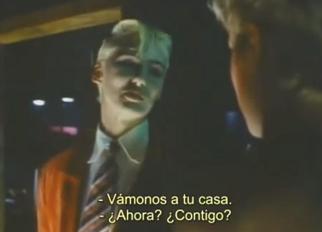
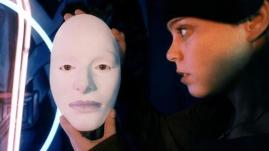
Ah, yes, New York City in the 80s. The downtown Scene of Liquid Sky, with its strangely unmelodic music, unwearable outfits and motionless dancing does indeed seem like Bohemia as imagined by an alien or emigre (or a suburban teen). And, of course, there's models, neon, Eurotrash, drugs, parties, fashion, philosophy, soap opera actors, performance art and multiple wardrobe changes. And, yeah, aliens.

 
"Delicious, delicious, oh, how boring."

So, our heroine is Margaret, is the classic pretty girl from a good suburban family who has turned into into a warpainted, substance-huffing scenster fashionista/victim. Or, as her girlfriend, Adrian the midget performance artist calls her, "an uptight WASP cunt from Connecticut." Margaret has no comment on being called this. Margaret has no comment on anything: She hasn't given a fuck in so long she's forgotten what giving a fuck even feels like.
 The ladies reside in a neon-bedecked apartment with a view of the Empire State Building. Back when you could afford that sort of thing on a petty drug dealer's salary. Now you'd have to be a real lowlife criminal to pay that kind of rent. Like a stockbroker or something.
 

We also meet some of the rest of our cast, classic New York characters all. The junkie artist who talks about Cocteau while he shoots up and sponges off of his girlfriend. The trust fund brat aka that "guy on the dance floor who's offering all the chicks cocaine." The professor who uses pretentiousness as both lure and repellant. The woman who has seen every scam and still falls in blind love with her eyes open. The nasty fashionista who says shit like "Frankly, this bird-of-paradise routine is done every day in Vegas--and better." The slumming Upper East Side matron who is tolerated for her wallet. The drug-huffing ambiguously gendered pretty boy...

Douse his hair in Clairol blue-black #124 and he's about half the guys i dated in my twenties. And, well, if it was an actual male, of course. For the hook here is that Anne Carlisle plays both Margaret and her nemesis, Jimmy, the male model.
Carlisle is slightly reminiscent of a wooden Tilda Swinton. After this, she went on to flounce through a bit as a transsexual in Crocodile Dundee and a five-minute guest spot on Miami Vice as a stewardess girlfriend of Don Johnson who dies when one of the coke-filled-condoms she's drug-muling ruptures. And a rather odd Liquid Sky-themed Playboy shoot.
So the upshot is that aliens land on the roof of Margaret and Lesbian Midget Performance Artist's apartment. Somehow the aliens feed off of some chemical produced in people's brains when they have orgasms (or get high). Now, consider that Margaret is frigid, but everyone wants to bang her. You can see the passive-very aggressive direction this is going...
Aside from the fiercest warpaint since Ladies and Gentlemen: The Fabulous Stains (okay, that was after, but whatever), Liquid Sky is also distinguished by its relentless whistle-screech-ring Fairlight synth soundtrack.The music was composed by director Slava Tsukerman, who also co-wrote the screenplay with Carlisle (And you thought multi-tasking was a millennial thing. You wanna see a holocracy, go to the set of an indie film in the 80s or 90s where everybody just fucking did everything. You'd haul half your apartment to some set somewhere and wind up cooking a mess of beans and rice for two dozen people. You'd rewrite your dialogue and then carry light kits up from the basement in three-inch heels and sequins.)
Liquid Sky remains an incredible time capsule of New York City and the East Village when it was full of intellectuals and artists and punks and weirdos and every now and then a Ukranian granny. Sure, the story is daft, but the plot is really just an excuse for wild outfits, weird dialogue and scenes that trap this moment in time and this particular species of urban hispter on video like prehistoric fossils in amber. Take the climactic photo shoot...
This, of course, culminates in the scene in which Jimmy and Margaret taunt each other before the crowd of giggling, shade-throwing voyeurs. He sneers at her for being "old" and "ugly," while she somehow manages to be more insulting in calling him "the most beautiful boy in the world."

One, they're the same person, so ugly and beautiful are illogical. Two, Margaret making "beautiful"--a word that everyone else throws at her--into an insult says something about how powerless being admired for surface can  make one feel. And, three, is #2 why she wins this? Well, that and she blows him--and you know what happens when someone gets off around Margaret, who has finally realized that having everyone you fuck dematerialize is kind of an impressive power to have. Also, another fine example of the "go fuck yourself" via drag, as also seen in Female Trouble.

And, well, i'll always have a soft spot for Liquid Sky for its influence upon me. You think i'm kidding? Fine. Here's "Margaret" in New York City circa 1982..
And me, in Poughkeepsie, circa 1986...

Thursday, June 12, 2014

Dinah East

Some movies take a little while to draw you in. My favorite example is Lola, a moody piece of sixties French pseudo-new wave cinema that seems bogged down in subtitled conversations about inanities and long shots of a seaside resort town. But somehow 45 minutes in, you realize you are fully absorbed in these people's lives and when the mandatory melancholy resolution occurs, your heart just breaks.
Naturellement, it's unnecessary to point out that Dinah East is not a work of art on a par with Jacques Demy's debut film. But the two movies do share a certain slow start that turns to fascination. But if Lola does it by building mood and character, Dinah East does it with sheer D-movie chutzpah. And a hell of a lot of full-frontal male nudity.
 Yes, nudity. And lots of it. Dinah East took the early-seventies trends for genderfuck films and old-Hollywood nostalgia and spent a few thousand dollars to maximize on them. Released in the same month as legendary trainwreck Myra Breckenridge, Dinah East tells the story of a fifties movie queen who, while she may really be a queen, ain't no woman. As happens in Tootsie, Dinah can't get a job as Chuck (or whatever her name originally was -- they don't say), so she comes back in drag and immediately becomes a star. The saga of Dinah's life and loves is told in flashback, which cuts back on costs for renting old-fashioned costumes (and allows for lots of tinkly fairybell noises to indicate a drift into the past) but also allows for a jaw-dropping gay bar scene. 
Why, yes, that is a pantsless man in pirate drag gyrating in a cage while a sailor watches.
And a Lawrence Welk bubble machine.

The movie not only wallows in the "she was really a man" cliche, but also throws around the "was really gay" trope not only for Dinah's paramours, but her best buddy, a costume designer played by Warhol superstar and Dali playmate Ultra Violet.
 Every female she sees immediately takes her top off, but it just makes Edith Head sad.

Dinah also somehow winds up with an adopted son, which i suppose could be some kind of reference to Joan Crawford or Loretta Young, but is really just an excuse to get some young tail in for the chicken hawks, as he does not materialize in the plot until he is of legal ogling age.

A not insignificant problem is simply that Dinah is not a very convincing drag queen. She still looks like a boy in a dress. I mean, no one is expecting Carmen Carrera-level fish-serving, but more polish was definitely needed. The outfits are not nearly over-the-top enough, which may be because they belonged to the producer, who was a biological female and apparently didn't realize that a little something extra requires a little something extra. And the wigs just suck.
See what i mean? Bitch looks like Nellie Oleson!

I wonder if they couldn't have helped matters by getting a better queen (Candy Darling, perhaps) but i also get the feeling that someone's boyfriend helped finance this project. Most of the actors have this as their sole credit -- granted, many came from "the stage," but the emotive skill indicates that perhaps said stage might have been the Gaiety Burlesque.
Boy? Girl? Whatever. The casting couch is the same for everyone, sweet cheeks...

Still, the barrage of increasingly melodramatic plot twists, bad acting and atrocious dialogue gradually builds into some truly engaging entertainment -- even if its engaging on a MST3K level. Dinah East is pretty ridiculous, but it's actually more amusing -- and subversive -- than many flicks that have more cult cred.

Sunday, January 6, 2013

Female Trouble

It's one of my favorite holiday movies, although Christmas is only about five minutes of it and i fucking hate holiday movies. It's one of the greatest female roles played by one of our finest interpreters of the feminine condition, although said actor is a male. It's sick, it's hilarious, it's profound, it's Female Trouble...
 
The great Divine stars in the tale of "Dawn Davenport. I'm a thief and a shitkicker and, uh, I'd like to be famous."
Our film starts where the story of any woman begins: The hallway at her high school. Dawn Davenport and her beehive are bitching and moaning about the cha-cha heels she wants for Christmas "and I'd better get 'em" she snarls to her buddies Chiclet and Concetta. (Before you go any further, feel free to go look at this song written for Divine about said heels, which was finally done by Eartha Kitt and Bronski Beat.... There's also this kinda lameish acoustic song about the movie, as well as this British pornopop band named after the shoes themselves. The cultural impact of Female Trouble, 'tis great indeed.)

In class, there's dress code violations, pop quizzes, gum chewing and "Dawn Davenport eating a meatball sandwich right out in class. And she's been passing notes!" More angst, more beehives, more threats of violence after school. Cue the Christmas music and the ranch house with its sad little wreath. I'd also like to note that Female Trouble features some of the ugliest wallpaper ever recorded on film.
Nope. She didn't get the shoes. "Nice girls don't wear cha cha heels!" hollers her father but Dawn doesn't give a fuck. She socks them both and knocks over the Christmas tree, balls n' all, pinning her mom underneath it. Back when it came out in the seventies, John Waters screened this film for the inmates of the Baltimore City Jail. He describes their deadpan reaction and his mounting nervousness -- he really wanted them to like it -- until the scene of Dawn's Christmas rampage, whereupon every felon in the house cheered and he had them for the rest of the film. Waters swears it was one of his proudest moments.

So, Dawn runs outside in her leather jacket and babydoll nightie and barely has a chance to stick her thumb out before she gets picked up by Earl. Earl is played by none other than Divine, with eyebrows grown back and in full-on butch mode. Like earflap hat and shitstained underpants butch. Divine fucks himself (herself?) on a trash pile and wouldn't ya know...
I haven't actually seen any episodes of Teen Mom, but I believe that this is how they all start.

There's the rejection by the nogood deadbeat babydaddy, the giving birth in a SRO and then we hit some truly magical montages. If you haven't noticed it yet, here is where Female Trouble will fully unfurl its classic "women's picture" roots. It's like a Joan Crawford movie gone mad or Bette Davis in Beyond the Forest: The saga of a woman going from bad to worse, with plenty of rotten men and delicious outfits, as well as some truly snippy dialogue along the way. Behold, "Dawn Davenport, Career Girl: 1961-1967."

Dawn continues into petty theft, child abuse, more ugly wallpaper, more tacky outfits, more sociopathy until on day she decides to get her har' did. And so she goes to the Lipstick Beauty Salon, owned by Donald and Donna Dasher (i have no idea if the reindeer reference is intentional or not) for the house specialty "warsh n' set."
There she meets the Dashers, who wear crazy outfits and audition their prospective customers. Dawn passes with flying colors (mostly chartreuse, fuschia, puce and a sort of bile green). It is around here that i begin to wish that one of Kim Kardashian's hair n' wardrobe queens (Sadly, you know she has some. Not the best, but they'll do.) would fuck her over by dressing her up in Divine's outfits from Female Trouble. I wonder how long it would take her to notice.
Seriously, the broad wears mesh-midriff whore dresses and a rat's nest of hair all the time -- how would she know? Hell, how would anyone? Except those of us in the secret club, of course... Anyway, Dawn winds up in the chair of Gator. Gator is a stringy-haired loser who speaks in an oddly inflected monotone ("I want to wuurk in tha aw-tow in-duh-stree.") and lives with his Aunt Ida, who is played by none other than the inimitable Edith Massey. Aunt Ida wants Gator to be gay, whining, "I worry that you'll work in an office. Have children. Celebrate wedding anniversaries. The world of a heterosexual is a sick and boring life!"
Again, the wallpaper is astounding. The rest speaks for itself. Aunt Ida spends most of her time squealing and shrieking and trying to set Gator up with a variety of seventies queens. However, her Susan Cabot-like efforts to fag-hag herself a lifelong companion by creating a clingy homosexual fail and he marries Dawn Davenport.
Yeah, going that D-list starlet/Vegas bachelorette party tourist flashing of the beav one better, Dawn Davenport has tits and bush on full display at her wedding. Miley Cyrus: You're engaged, take note!

Taffy grows up into the shrieking, smashing, biting child from hell, even more so once she is old enough to be played by Mink Stole, whose sneering, deranged performance deserved an Oscar nomination if not the win. (Ingrid Bergman won her third for Murder on the Orient Express, beating out the magnificent Madeline Kahn as Lili Von Shtupp. The fact that neither Empress Kahn nor the ultimate diva of supporting players, Thelma Ritter never won is a subject for another time.) If the mother's curse of "a child just like you" is truly valid, the infuriating, demented Taffy is just what Dawn Davenport deserves. Mink Stole is at her best when venting her rage at her pieceashit stepdad, responding to questions with a roar of "Writin' a book, hippie?! Why don't you go listen to some folk music and give me a break!" or repulsing his advances with one of the most brilliant lines in movie history, delivered with a level of contempt that cannot be measured on most human scales...

"I wouldn't suck your lousy cock if I was suffocating and there was oxygen in your balls!"

Oh. Snap. Oops upside your head. However, like most marriages and especially those in women's film, it begins to go south and not in a fun way. Standing on the stairway, Dawn Davenport announces, "I'm going to sink into a long, hot beauty bath and try to erase the stink of a five-year marriage" in a moment I'm pretty sure happened to Mary Astor or Kay Francis at some point.

But how fortunate that the the end of her marriage coincides with and exciting new career opportunity provided by the Dashers."Would you allow us to take some photos of you committing various crimes. Crimes that tickled our fancy.... We have a theory that crime enhances beauty. The worse the crime gets, the more ravishing one becomes."
The Dashers are prescient characters and I'm not just talking about the how the technicolor wackos in The Hunger Games rip them off in style, demeanor and plot function. It's the institution of reality TV itself -- wealthy snobs seeing the money to be made in exhibiting the foibles and failings of vulgar, lower-class America. The Dashers' contemptuous-yet-compelled dialogue as they make their way through Dawn Davenport's slum neighborhood is probably the same exact conversation the producers had in their Escalade on the way to Honey Boo Boo's house.

Waters knows this, citing Donna Dasher's prissy request for "I'll have two chicken breasts please," during Dawn Davenport's spaghetti dinner. As he says in his wonderful DVD commentary, "They are saying that before anyone did that. Ordering off the menu -- then it was a joke. Now everyone does it... It infuriates me. In L.A. they constantly say that now." What was once an indicator of profound assholism is now accepted special snowflake behavior.


Although what i really wish is that that dim bint Tyra Banks would stop scrambling for crap photo shoots like "dress up as Michael Jackson and be judged by LaToya!" and do a Female Trouble shoot. Suffice to say that Dawn Davenport goes all-in for "crime is beauty." There's some acid-in-the-face, some amputation, some infantcide, some mass murder, a trial and a trip to the electric chair. But Dawn Davenport remains supreme and undaunted, a veritable Nietzschean superwoman.

It's ultimately kind of difficult to write up Female Trouble because i feel like it all just comes down to you have to fucking see this movie! As Donna Dasher says, "Together we can overcome this boredom that imprisons us all!"