Showing posts with label serial killers. Show all posts

Wednesday, November 5, 2014

Theatre of Blood

Oh, the ham of it all!
Theatre of Blood was apparently one of Vincent Price's favorites of his (over 100) movies and i can see why. It's got everything that an actor enjoys: Multiple roles, varied accents, death scenes, murders, vengeance and the opportunity to play eight Shakespearean characters, down to the makeup and the monologues. This literary twist is another factor that sets Theatre of Blood from other hack horror flicks: The use of Shakespeare adds both substance and style and the Bard is handled with wit and dignity, albeit an off-kilter variety.
Theatre of Blood is a tale of murder (and revenge) most foul. Its murders may be based on Shakespeare, but its real theatrical roots are in the Jacobean Revenge Tragedy and the Grand Guignol (Sorry, my time at NYU art school popping up there...). Like the British theatre genre of the 1500s, Theatre of Blood has a taste for bloody violence, complicated Rube Goldberg-like vengeance plots that involve family members and no one left alive onstage. With the French Guignol of the 1900s, it shares a taste for black humor, cultural references, elaborately staged deaths and no one left alive onstage. Highbrow art in a lowbrown format, mixed with comedy, horror and camp: How can we not be entertained?
Price plays Edward Kendal Sheridan Lionheart, a pompous actor who refuses to do anything but Shakespeare.  When he fails to win the Critics' Circle Award for Best Actor of the Season 1970, he commits suicide... or does he?
Lionheart is survived by his daughter, played by Diana Rigg. At the time, she was between The Avengers & On Her Majesty's Secret Service and Hedda Gabler & The Orestia. Why is she slumming here? Well the same reason as Vincent Price: Fun for an actor, disguises, Shakespeare. And, i'm sure it was also an asset to be working with Mr. Price, whom she described as "an absolutely adorable man." He was also known for making his co-stars delicious gourmet meals for on-set lunch. And then they'd go back to hamming it up...
But Edward Lionheart is not dead! He's just crazy! And he decides to inflict his revenge upon those that hath scorned him. One by one, he kills each theatre critic in the manner of  a death from a Shakespeare play: The strangling from Othello, the mass stabbing from Julius Caesar, the cook-your-children-in-a-pie-and-eat-them of Titus Andronicus, and many, many more!

Of course, being an actor, Lionheart cannot function in solitude. So he recruits about a dozen way-far-gone winos -- actually, they seem to be drinking a mixture of grape Faygo and Everclear -- who serve as cheering audience, supporting cast and production assistants, as well as the occasional henchman, factotum or Doppleganger.
He also has a less-incoherent helper, a young man tricked out in Roger Daltrey hair, Robert Redford mustache and Peter Fonda sunglasses. It's still unclear how Lionheart manages to arrange his elaborate plots, which require not only undisturbed use of an abandoned theatre, but the bankroll and connections to arrange for complete film shoots, entire fencing schools, bone-cutting saws, police vehicles and suchlike.
All of the "He's not dead!" and revenge-death-as-literary-tribute in Theatre of Blood may seem reminiscent of Price's The Abominable Dr. Phibes (made two years earlier) and indeed it is. Although this movie kills critics instead of doctors with Shakespeare plays rather than Biblical plagues. Said critics are played by nine British character actors who naturally also fall into the film's spirit of scenery-chewing. (One of them, Coral Browne, married Price after filming ended.)
While considered a bit of schlock in its time, Theatre of Blood has become more appreciated over the years as a great piece of camp and a tour de force for a beloved star.. The movie has been the subject of book and articles, had screenings at the British Film Institute, a stage version and, of course, action figures and coffee mugs. Always with the action figures and coffee mugs...

Sunday, January 19, 2014

Screaming Mimi

The black-and-white B-movies of the 50's and early 60's have always been dear to my heart. There's something about the glossy monochrome cinematography and high heels/maquillage style that breathes class, yet the plotline and characters often exude sleaze. They bridge the time between noir's slightly sordid grace and exploitation's vaguely glamorous seediness. And so we have Screaming Mimi.
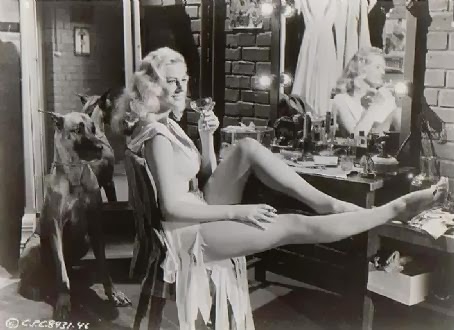
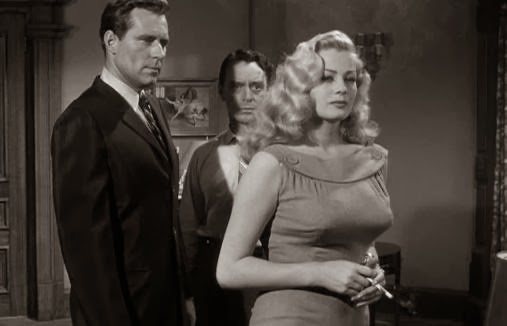
Strippers! Serial killers! Weird overtones of bondage, bestiality, dominance and voyeurism, not to mention all manner of insanity and a whole lesbian sideplot they don't even try to obscure. And if the glorious pulchritude of Anita Ekberg isn't enough to provoke you, there's also the wit and glitz of Gypsy Rose Lee and the swingin' sounds of the Red Norvo Trio

Screaming Mimi is based on the pulp novel of the same name by Frederic Brown.
So the film opens with our heroine, Virginia (Ekberg) rising up out of the ocean like Venus, hair streaming, bosom heaving. She immediately takes a shower in a nearby outdoor stall when -- BAM! -- an escapee from the local Hospital for the Criminally Insane jumps outta nowhere waving a knife. (Exactly the thing that you always fear will happen when you take an outdoor shower. And, yes, this does pre-date Psycho.) She screams until her brother (stepbrother, actually) rushes out of the house and shotguns the lunatic. Just like Joe Biden would.

Anyway, irony of ironies Anita herself gets locked up in the same mental hospital. She spends some time sedated and straitjacketed (That actually sounds kind of relaxing...) and then having a little talky therpy with her doctor, who insists through glassy eyes that he'll "do anything for" her.
In what is obviously a commonly accepted theraputic move, the not-so-good-doctor is now "managing" his patient in her new gig dancing in Gypsy Rose Lee's club, one of those fabulous clubs with cabaret acts and a happening band that only exists in old movies of a certain era. Not only do they have the Red  Norvo Trio, vibes and drums a-clangin', but they have singing bartenders and dancing waiters, but in a way that isn't annoying. Gypsy Rose Lee barrels though, looking svelte in sequins, boisterously exhorting customers to "Drink up! You're on an expense account and my rent is due!" Hell, make it a round for the house and doubles to boot!


Our heroine, now calling herself "Yolanda Lang" is headlining doing a sort of fetishy sleepwalk with manacles and ropes. Despite her bodacious dimensions, Ekberg is easily dominated by her Buscemi-esque Headshrinker/Svengali, who won't let her talk to anybody, but is happy to take the cash she makes writhing in front of strangers. Fucking typical. 

Here we meet our sorta hero, a reporter who covers nightlife and, as such, is quite interested in nightclub dancers. He's especially interested in Anita....

"How tall are you?"
"With heels?"
"With anybody."
Walking home after this obviously Pulitzer-quality interview, Anita is attacked by (yet another) knife-wielding psycho, but this time her loyal, giant, vicious dog runs the guy off. Then Ace Reporter fortunately shows up (he happened to be riding along with the cops, Weegee style) to handle the dog. And point out to us that there's a "ripper" slashing blonde burley dancers. Blonde burley dancers who all seem to own the same tchotchke of a screaming woman, the "Screaming Mimi" of the title.
 Ace Reporter chases the statue around for a while, as we drum our fingers on the armrest and wonder when someone's going to remember that Joe Biden Stepbrother is a sculptor. So we watch him dick around, groping toward the obvious. The highlight of this is a visit to Gypsy Rose Lee's sleek mid-century pad, where she drinks cocktails in a fur-trimmed hostess gown while the teenage cigarette girl she obviously keeps dances around in ponytail and fishnets. If that wasn't wild enough, it's made pretty clear that Gypsy and Jailbait have been not just banging, but kicking the gong around as well, as indicated by Ace Reporter's comment on the smell and Gypy's blase, "A maiden lady aunt of mine just visited San Francisco, brought me some incense. From Chinatown."

"How's your psychosis today?"
"I just came up for a little gin and... sympathy."
Gypsy Rose Lee dons her beaded fringe gown (the one Dita Von Teese recently bought at auction) and shimmies through a rather tepid "But the Blame on Mame." One sees a flash of what made her great during the vibe solo, when she forgets the "singing" and displays her flair for flipping her fringe and her fox fur. Afterward this bunch of gorgeous swingers in their posh club have a party with cake and barbershop quartets. Ekberg ducks out, later to hook up with Ace Reporter -- their love scene, lit by the alternating brilliance and darkness of a neon sign is a clever and stylish, yet touching piece of cinematography. Creepy obsessive Ace Reporter is marginally better than creepy, obsessive Headshrinker but, either way, the amount of hairgrease that these guys wear alone should have set off red flags for even a chick playing with a half a deck.
Headshrinker keeps menacing Anita -- "You want to go back to being locked in a cell?!... You're nothing without me!" Little tchotchke statues come and go, various story twists and gaping plot holes, disconcerting moments and lovely tableaux. Ekberg isn't the best actress, but she is supposed to be foreign and somewhat out of it, which neatly covers her shortcomings. This is apparently the film that Fellini saw that inspired him to cast her in La Dolce Vita and one can see why: She has the lauded "flesh impact" of other movie bombshells, although on a slightly larger scale. As Dashiell Hammett said in Red Harvest, "it was like someone set out to paint a picture of a beautiful woman and ended up with a mural."
The high-contrast black-and-white cinematography (photographed by four-time Oscar nominee Burnett Guffey) and hip, vibe-heavy jazz soundtrack give Screaming Mimi a polish that other sexploitation flicks lack. But while the gloss on top may have a bit of the A, the confusing plot, seedy milieu, sleazy menfolk and erratic performances place it firmly among the Bs. Screaming Mimi is a throwback to glamorous, subtext-heavy noir that also looks forward to the psychological exploitation flicks and Giallos of the next decade.

Sunday, August 18, 2013

Perfect Blue

Do not let the pretty face fool you. This is not the anime you think it is. Perfect Blue owes far more to David Lynch than Disney.
The plot of Perfect Blue can best be summed up in one word: Mindfuck. It is a story in which the idea of being unsure what is real and what is fantasy is the story. The main character becomes entangled in the different worlds she inhabits: Her real life, her online life, her memories, her dreams, a character she plays on TV, someone else's imitation of her, who her fans think she is. And then people start dying...
Our heroine is Mima Kirigoe, who sings in Cham, a B-grade J-pop group. She does meticulously choreographed arm-waving and twirling in a pink tutu, crooning sugary tunes about love and angels to little girls and fixated fanboys, three of whom serve as a kind of Greek Chorus throughout the film.

Mima isn't satisfied with the low-grade, malls-and-fairs fame of her singing group. We open with her last show before she quits for a new and hopefully more glamorous and lucrative career as an actress. She's been offered a role on a sordid, sex-and-violence police procedural -- there is much debate about her pop idol image vs. actress image, how hard it is to become famous and stay famous.


She lives in a tiny, cluttered apartment, shops for groceries, feeds her fish, rides the train, lives a pretty ordinary life aside from the occasional fan letter... but then she begins getting odd hang-up calls, peculiar faxes, strange notes and then there's the website. Someone has set up an intensely detailed "fan site" for Mima, all in first person and accurate down to the brand of milk she buys. And then there's an accident with an exploding letter...
Things accelerate when Mima's role on the TV show is expanded -- via a graphic gang-rape scene. (This sequence is especially disturbing and disorienting.) Her pretty, pure, pink-clad pop idol self haunts her, taunting her in the window of a passing subway car, cursing her from a mirror's reflection, mocking her from "her" website about being a "filthy slut" with a "tarnished image."

Then the show's writer is murdered. Mima does a nude photo shoot. The photographer is butchered. And much as Mima doesn't know where she is, neither do we. A murder turns out to be a TV show episode that is actually a dream but is really a murder after all. The turn of the millennium brought a number of "what is real" movies, like Fight Club and Memento and Perfect Blue may be the most multi-layered example of the "tumble down the rabbit hole" genre.
 Darren Aronofsky was a fan of Perfect Blue and contemplated doing a remake ( I, uh, knew somebody who was in a position to know and let's leave it at that.), but i do not see how it could possibly be done live action. (Also, there are some movies that are done so right the first time, there's no point in a remake. I wish more filmmakers would realize that.) One doesn't have to pay a whole lot of attention to see the inspiration of Perfect Blue in Black Swan -- the idea of a young woman trying to move from mid-level fame to stardom by exploiting her sexuality and haunted by an alternate version of herself.

Perfect Blue is prescient on a number of counts: Stalkers, creepy fans, people tormenting others by pretending to be them on the internet, the never-ending amping-up of sex and violence for TV ratings, how teenybop starlets go "adult" via scandalous photo shoots and cameo roles. At least the bizarre fate of Mima Kirigoe isn't any any more twisted and self-destructive than Britney Spears, Lindsay Lohan or Amanda Bynes....

Saturday, January 21, 2012

Blood and Black Lace

I love Giallo films. Not so much because i'm a horror fan, but because i'm a sucker for aesthetic extravagance. I wish i could flounce around in the minidesses and go-go boots of All the Colors of the Dark, listen to The Bird With the Crystal Plumage's avant-garde groove soundtrack, live in Suspiria's pop art deco nouveau sets (through i'd redo the razor-wire closet). Cosmopolitan Italy in the late sixties/early seventies was a post-La Dolce Vita world of luxury, fashion and rancid decadence and, ultimately, Blood and Black Lace is more gorgeous than it is gross.


It is 1964, somewhere in Italy, a world in which everyone has beehives for hairdos, cat eyes for maquillage, works in a palazzo and lives in a penthouse. We quickly find ourselves in that old "serial killer who only whacks models" trope. Somehow her battered and rain-soaked corpse makes it back into a (seventeenth-century antique French provincial) wardrobe, from which it falls at the feet of her (astonishingly coiffed and chicly attired in a little black dress) employer. Stoic detective soon rounds up the usual suspects in the murder of any model -- her boyfriend, her agent, her best friend and her coke dealer.
Then dead model's diary shows up backstage at a fashion show -- a scene in which all the eurosleazy fashion folk alternately eye each other and The Purse in portentious closeup is glamorous and hilarious at the same time. (The don't want it because it's part of the auto-inspired Prada spring collection, but because it contains the incriminating diary. Although, given this crowd, i figure they also hope there's an eightball stuck in the lining somewhere.) The entire fashion show is a masterpiece orchestrated shots and multiple fields of activity, as well as a full-on vintage haute couture experience.


Other models soon meet their deaths is more elaborate set-ups -- such as a cat-and-mouse in an exqusitely labrynthine antique store, soaked in red and blue light and a mounting sense of dread, leading up to facial impalement via historic torture instrument. Stoic Detective decides to arrest all of the male characters, who react with everything from disdain (silly mustache) to dismay (the dead ringer for Peter Lorre) to shrieking "Look at his face! He hates women! He's the murderer!" and collapsing into an epileptic fit (shiny suit and bad pompadour). The models pose about the fashion house, equally fastidious and frightened (and rather distressed that all their menfolk are gone).

Yet the murders keep on happening! Not that the models don't help. As in: When a serial killer is on the loose and you are too afraid to even go home, when you find that multillated corpse in the trunk of your car, don't drag it inside, hide it and send all the other people in the building away. Do not add insult to stupidity by stripping down to a black slip to make your inevitable demise sexaaay. The killer is eventually outed with Scotch and stopped by architecture (so much for Stoic Detective). There's a theoretical reason why all the models were killed but, as we all know, it was mostly because they were models and the killer was a killer.

Again, the appeal of Blood and Black Lace is definitely more style than substace or perhaps style as substance. The fashion is more than simple (window) dressing, but forwards the plot -- no one wants to wear the black lace dress that the first dead model was supposed to wear in the fashion show. Even in ominous moments, i find myself more fascinated by a near-her-expiration-date mannequin's rose satin sheath dress under a raspberry wool swing coat than the fact that she's about to die or i'm  focused on the Henry Clarke-like tableaux instead of the plot points being hit.But, well, i'm enjoying myself and what other point could there possibly be...