Tuesday, April 30, 2013

His Kind of Woman


When you think of great teams from the golden age of cinema, you may think of Loy and Powell (Who doesn't adore them?), Rogers and Astaire (Who doesn't enjoy them?), Hepburn and Tracy (neither of whom i've ever particularly liked).  But my favorite may be Robert Mitchum and Jane Russell, two actors that never seemed to give much of a damn about acting. Russell seemed perpetually bemused onscreen -- movie stardom beat the hell out of working in a chiropodist's office, but so would a lot of things. As for Mitchum, his nonchalant savoir-faire is the stuff of legend. The man rolled through freight trains, chain gangs, cowboy movies, weed busts, film noir, endless spread-thighed starlets, Calypso albums, Technicolor blockbusters, fifty-something years of marriage, international superstardom -- all this, half-asleep and completely blase.
His Kind of Woman was their first film together, a kind of screwball noir. It was made at RKO during the Howard Hughes era, back when the mogul was only slightly deranged, but he still made films according to fetish and whim -- and fetish and whim with inexhaustible financial backing can sure drag out production time. Thus, His Kind of Woman took over a year to shoot (Vincent Price apparently threw a swingin' party to mark his first anniversary of being on the set), had two directors, three villains and was stopped about five times for rewriting, recasting and/or reshooting.

It opens a bit slow, with a lot of panning back and forth across maps with droning voiceovers. (It's better than a cheesy montage, but not better than a cartoon plane moving across the big map.) and some guys in suits babbling in front of some ugly art. Then some other guys in ugly suits play cards. All of this happens in low angle shots with heavy chiaroscuro. Finally, Robert Mitchum shows up, trades quips with the diner counterman, beats up some ugly suits, passes out, wakes up, answers phone. "No, I'm not busy. I was just getting ready to take my tie off. Wondering if I should hang myself with it." Naturally, poor Mitchum is getting set up by all the suits. He's being paid off to go hide out in Mexico for a year and... well, he's not sure, but he'll take the money and head south and see what happens. Robert Mitchum is not one to fight fate. Unless it hits him first. Or insults his buddy. Or knocks over a cripple. Or slaps a dame around. But fate (or Jane Greer) totally has to make the first move...

Their meeting is exactly as it should be. Mitchum tinkles the piano while Russel preens in her compact, both feigning obliviousness while putting on a show. He offers her a drink, she announces, "I'm drinking champagne." Mitchum one-ups her by pulling out an already uncorked bottle with a wry grin. Russell one-ups him by pulling out a bottle of her own, raising an eyebrow ever-so-slightly. He shrugs, reaches for the glass, "Where's yours?" She's a singer and, uh,  socialite who just happens to be hanging around this seedy bordertown bar, waiting for a plane out of the country.

Russel was always oddly believable in these jaded woman of the world roles -- one, she seemed like she could take care of herself (Look at her: If she socked a fella in the jaw, it would hurt.) and, two, she seemed to have alternately fended off and absorbed life's slings and arrows with more humor than pathos. And whatever exotic locale you drop Jane in -- Mexico, Macao, Minneapolis -- she's always popular with the locals.
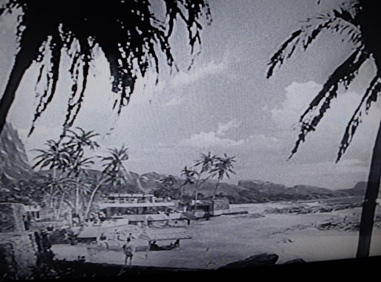
Another pan across maps, this time to Mexico to the most fabulous mid-century tropical resort ever constructed on a soundstage. We will stay at Morro's Lodge, as it is called, for much of the remainder of His Kind of Woman because, frankly, who would want to leave? It's introduced to us in a glorious tracking shot, following two blondes (Look closely! One is Mamie Van Doren back when she was still Joan Olander.) and their sugar daddy up from the beach, then losing them in the lobby, picking them up again in the bar, then losing them again on the dance floor before swinging around to catch Robert Mitchum coming in from the pool.


Everyone's wandering around in Hawaiian-print shorts and wiggle dresses, wanting to play gin rummy or go hunting or have a martini or play chess or sunbathe, surrounded by palm trees and white sands, googie prints and vertical blinds. Even Thurston Howell III himself is in the house!

Mitchum is still wondering why he's here. (So am i, when i remember to.) He skulks around the lobby, has a lot of enigmatic conversations and listens to even more. The avuncular resort host, the jolly guy in the ugly shirt, the newlywed degenerate gamblers, the misanthropic German chess master -- none are what they appear to be.
(Admire the mosaics on the pool deck.) Despite all the noir baroquery, Mitchum weirdly sticks to sipping milk and ginger ale in His Kind of Woman, odd for one of moviedom's and, indeed, humandom's greatest drinkers.
"I'm a professional gambler," he explains to one of the many persons of interest loitering around the Morro.

The response: "Who isn't?"
And, hey! Look! It's Vincent Price! Price plays movie star Mark Cardigan, sometime playmate of Jane Russell. (Yes, those are tailfins on Jane's bodice. And dig the tiki lamp over Price's shoulder.) It's a delightful performance that really powers the second half of the film, rife with with humor, a certain smarmy charm and thespian self-parody. A scene in which he watches himself in his latest hokey epic is especially droll.
We also discover that Jane Russell is no woman of wealth, but rather a lounge singer who is impersonating a member of the leisure class in order to snag a high-class husband. (Career options for women were more limited in those days, when the only way to make a nice life for yourself was to get some guy rich enough to foot the bills to wanna fuck you badly enough that he'll put a ring on it.) The lady was chasing the ham, but now that he's turned up with that wife that he told Jane was "separated" from (like they do), she's rethinking going back to the piano bars and possibly...
....Oh yeah, gurrrrl, i'd be seriously thinking about it too. Anyway, Mitchum is still hanging about amidst the foliage and parabolas, flirting with Russell, smirking at Price, trying to figure out what he's doing South of the Border for this five grand. Eventually he hooks up with some FBI or CIA or IRS agents who are trying to catch the mobster who is trying to steal Mitchum's identity (Aha!) but as soon as that can happen, one of 'em gets whacked and then it's on! Mitch and Price wind up in a beachside shootout with the bad guys -- hack actor Price keeps forgetting he's not in one of his movies, meaning he's alternately impressively cool and totally ridiculous.
Here is where the plot of His Kind of Woman goes completely two-faced. Mitchum bum rushes the mobster's yacht and is quickly overpowered and winds up subject to a series of particularly fetishy tortures at the hands of (identity-thieving mobster) Raymond Burr and chess Nazi and a half-dozen burly muscleman types. (Apparently this series of steam blasting, goon-beating and experimental drug-injecting was one of the things Hughes fixated upon and kept doing and redoing over and over. Makes ya wonder....)

But in the meantime, Vincent Price mounts a slapstick rescue attempt, spouting Shakespeare as a group of bewildered Federales try frantically to row their sinking boat. About the only believable moment is that Price only keeps Russell from joining the effort by tricking her into getting locked in a closet -- because you know she's not the kind of dame to wait around at home and hope for the best.

Eventually Mitchum kicks the shit out of all the villains (Not unrealistic: After over a year of shooting and endless retakes of getting punched in the gut, Mitchum finally snapped one night and completely destroyed the set.) after Price and posse provide a diversion. Evil is dispatched and Bob and Jane are reunited for some final cynical repartee before the final clinch -- she pours the champagne, he irons out the few dollar bills they have between them....
Mitchum was always greatly underrated as an actor. (Check out this old clip of "What's my Line" at 17:00 to observe his Streep- or Williams-level ability to fake a variety of accents.) Charles Laughton (Mitchum's director in Night of the Hunter) once said, "He'd make the best Macbeth of any actor living" and Laughton has a point. Mitchum always played a man manipulated by women into things he would normally find morally reprehensible (well, he still thinks it's wrong, but he's doing it anyway).

A great part of the charm of His Kind of Woman is in its curiously schizophrenic air -- which was surely abetted by its repeated reshoots and bizarre production history. Mitchum inhabits a violent noir film, rife with plot twists and beatdowns. Russell lives in a sort of romantic dramedy, girl torn between posing as an heiress with a wealthy schlub or going back to her life as a singer with the hunky broke guy. And then there's Vincent Price's comedy/parody, with its cast of eccentric characters, self-referential twists and slapstick scenarios. The stories separate, loop back, come together, then split again, all at a fast pace with clever dialogue. Logical? No. Entertaining?  Hell, yes!

Besides, if you ever wanted to see what Vincent Price looks like in the kitchen cooking a chicken, here's your opportunity.

Thursday, January 31, 2013

The Jayne Mansfield Story

Remember that awful Liz Taylor TV movie with Lindsay Lohan? Yeah, me neither, really, although i know i watched it... but i brought up the Jayne Mansfield TV movie with Loni Anderson as a finer example of a trashy TV biopic. Then, lo, i got the DVD for Christmas. The stars seemingly being in alignment, i give you The Jayne Mansfield Story.

The movie is based on the book, Jayne Mansfield and the American Fifties by Martha Saxton. It's one of those rare biographies that treats its subject with affection, yet pulls no punches. Even better, it places Jayne in context to the changing times she lived in, how she manifested them and how they ultimately ruined her.

Casting Loni Anderson at her WKRP in Cincinnati peak as Mansfield was an inspired idea -- while she may not look alike in the face, the rack is close to accurate and she's got the giggle, the wiggle and the jiggle for the role. Even more inspired was the casting of Arnold Schwarzenegger -- exactly halfway between Pumping Iron and Conan the Barbarian -- as Mansfield's musclehead hubby, Mickey Hargitay. He delivers a good bit of the narration -- the movie's framing theme is Mickey talking to an unnamed lady journalist about Jayne. He's expectedly wooden and weirdly earnest (present-day scenes with polyester sportcoat straining at the shoulders and light brushing of gray powder at the temples, flashback shots in a series of banana hammocks).

We kick off with the classic "open with the defining moment of the subject's career" gambit -- in this case, the car crash. LoniJayne is wrapping up a gig at a skeezy club in Biloxi, wriggling in a ghastly spangled dress and cheap Barbie wig. (sadly, this is all absolutely true) Then it's into the Buick, try to pass the semi in a cloud of fog and BANG!

Brief misty-eyed Ahnold, then it's back back back back to a brunette Jayne babysitting her toddler daughter while working the popcorn stand at a movie theater -- and, presciently, getting her picture taken with a chimp at a movie premiere (not accurate, but this movie was made during the Reagan years after all...) Jayne explains to adorable tyke that "Oh, I don't think daddy's ever coming back....He doesn't understand those auditions mommy's always going on."

Jayne bulldozes herself into an agent, but blows her first big audition for a bimbo part by insisting on doing a monologue from "Come Back Little Sheba." She quickly realizes that her biggest asset is what's filling out her sweater and decides that "I'll just sell the cheesecake until I'm famous." Of course, this will be Jayne's downfall, as she keeps putting off her ideals of being an actress, a wife, a person until she hits some magic level of famous. It's always just out of her grasp, but once she gets there, she's gonna only do serious roles, get married, spend more time with the kids, write a book....

But, until then, it's about making "Jayne Mansfield" and "big boobs" virtual synonyms, taking any schlocky movie role that comes her way, posing for any photo, opening any supermarket and using "Get me the Playboy Mansion, I want to talk to Hugh Hefner" as her answer to every setback. LoniJayne sports a variety of wild outfits of that special eighties-version-of-the-fifties variety: Everything is pink, sequined, polka-dot, leopard-print or all of the above. The costumes are even more over-the-top than the original Jayne outfits.

"You know, mommy got a lot of money for posing for those pictures. It's gonna help us to get out of here." (Add this to the list of things one hopes that one never says, along with "Here's my PIN number" and "I don't think it's my blood.") Jayne gets Will Success Spoil Rock Hunter? by repeatedly dropping her towel. And it was only a hand towel to begin with.
Or, as Ahnold would say, "She was the center of attraction."
The two great chests meet and fall head over heels -- as Schwarzgitay incessantly bellows, "I loff you Jaynie!" Mansfield is at the pinnacle of her fame -- a short-lived pinnacle, not that she even suspected that. They move into the Pink Palace, replete with heart-shaped pool. (Unfortunately, it's not the real thing. Also in the "alas" department, we do not get any scenes about or any reference to Jayne's involvement with Satanism and palling around with Anton LaVey.) Though you wouldn't think it, The Jayne Mansfield Story passes the Bechdel test easily, as Jayne talks about her career with everyone she comes across. Sure, she loves Mickey. But she loves her career and herself more. And her kids. And her chihuahua. And vodka. Jayne develops a very special relationship with vodka.

Jayne gets so caught up in trying to get famous, she forgets what she wanted to be famous for. As the films get worse and worse and the publicity gets tackier and tackier, Jayne drinks more, yells more. I suppose in a way, you could say The Jayne Mansfield Story is all of our stories. As what we meant to be and what we are slide further and further apart, holding it together becomes more and more of a strain -- and almost impossible to do while simultaneously remaining bubbly and cheerful and stacked and compliant.
"But I'm a movie star. That's what I do." The seams do start to show, fraying even further as fifties cartoon bombshell Jayne becomes an anachronism in the Twiggy/Joplin sixties. Jayne stands on her balcony as tour buses cruise by, waving frantically with one hand, clutching her ubiquitous vodka in the other. She breaks up with her agent and spends most of her time loaded, staggering around the Pink Palace, howling, "Dammit, Carol Sue, where's the vodka!?" and yelling at the kids about their damn music. Her sodden, pathetic/sympathetic/narcissistic reaction to Marilyn Monroe's death is eerie, as she dreamily, soddenly intones that she's the last blonde standing without realizing that's no place to be.
And we wind up back where we started, in a cheap joint in Biloxi, as tawdry, tipsy Jayne croons and squeaks over the balding pates of pudding-jawed businessmen.

Loni Anderson is totally credible as Jayne Mansfield and it's easily the best work she ever did. (And i say this as a big fan of her as Jennifer The Receptionist on WKRP in Cincinnati, a rare example of the busty bombshell as the smartest, most competent person in the room.) Schwarzenegger isn't bad as Hargitay -- essentially, he's a well-meaning yet clueless Eastern European guy with barbells and biceps. Not much of a stretch, although this Mickey is smarter and more successful than the real thing.
This poster, however, is creepy. Arnold is unrecognizable, rendered in the Tijuana drugstore mural school of art, and that isn't even Loni -- it's an old Playboy photo of Jayne colored in with a paint-by-numbers set.
So, again, if you want a schlocky-yet-moving TV biopic, The Jayne Mansfield Story should be your go-to. (Did you know that Siouxsie and the Banshees' "Kiss them for Me" is about Jayne Mansfield. Listen to the lyrics... i'm pretty sure Siouxsie wrote them after watching this on late-night TV.) If you need a backup, Mae West starring Ann Jillian is also surprisingly good (hey, it has Roddy McDowall). However, bypass all of the many Marilyn Monroe TV biopics, as well as Rita Hayworth: The Love Goddess starring Lynda Carter. (Even as a wee lass, i never really forgave Wonder Woman for what she did to Gilda.) And even i could not summon up enough hatewatch for Jennifer Love Hewitt as Audrey Hepburn. You're on your own with that one.

Sunday, January 6, 2013

Female Trouble

It's one of my favorite holiday movies, although Christmas is only about five minutes of it and i fucking hate holiday movies. It's one of the greatest female roles played by one of our finest interpreters of the feminine condition, although said actor is a male. It's sick, it's hilarious, it's profound, it's Female Trouble...
 
The great Divine stars in the tale of "Dawn Davenport. I'm a thief and a shitkicker and, uh, I'd like to be famous."
Our film starts where the story of any woman begins: The hallway at her high school. Dawn Davenport and her beehive are bitching and moaning about the cha-cha heels she wants for Christmas "and I'd better get 'em" she snarls to her buddies Chiclet and Concetta. (Before you go any further, feel free to go look at this song written for Divine about said heels, which was finally done by Eartha Kitt and Bronski Beat.... There's also this kinda lameish acoustic song about the movie, as well as this British pornopop band named after the shoes themselves. The cultural impact of Female Trouble, 'tis great indeed.)

In class, there's dress code violations, pop quizzes, gum chewing and "Dawn Davenport eating a meatball sandwich right out in class. And she's been passing notes!" More angst, more beehives, more threats of violence after school. Cue the Christmas music and the ranch house with its sad little wreath. I'd also like to note that Female Trouble features some of the ugliest wallpaper ever recorded on film.
Nope. She didn't get the shoes. "Nice girls don't wear cha cha heels!" hollers her father but Dawn doesn't give a fuck. She socks them both and knocks over the Christmas tree, balls n' all, pinning her mom underneath it. Back when it came out in the seventies, John Waters screened this film for the inmates of the Baltimore City Jail. He describes their deadpan reaction and his mounting nervousness -- he really wanted them to like it -- until the scene of Dawn's Christmas rampage, whereupon every felon in the house cheered and he had them for the rest of the film. Waters swears it was one of his proudest moments.

So, Dawn runs outside in her leather jacket and babydoll nightie and barely has a chance to stick her thumb out before she gets picked up by Earl. Earl is played by none other than Divine, with eyebrows grown back and in full-on butch mode. Like earflap hat and shitstained underpants butch. Divine fucks himself (herself?) on a trash pile and wouldn't ya know...
I haven't actually seen any episodes of Teen Mom, but I believe that this is how they all start.

There's the rejection by the nogood deadbeat babydaddy, the giving birth in a SRO and then we hit some truly magical montages. If you haven't noticed it yet, here is where Female Trouble will fully unfurl its classic "women's picture" roots. It's like a Joan Crawford movie gone mad or Bette Davis in Beyond the Forest: The saga of a woman going from bad to worse, with plenty of rotten men and delicious outfits, as well as some truly snippy dialogue along the way. Behold, "Dawn Davenport, Career Girl: 1961-1967."

Dawn continues into petty theft, child abuse, more ugly wallpaper, more tacky outfits, more sociopathy until on day she decides to get her har' did. And so she goes to the Lipstick Beauty Salon, owned by Donald and Donna Dasher (i have no idea if the reindeer reference is intentional or not) for the house specialty "warsh n' set."
There she meets the Dashers, who wear crazy outfits and audition their prospective customers. Dawn passes with flying colors (mostly chartreuse, fuschia, puce and a sort of bile green). It is around here that i begin to wish that one of Kim Kardashian's hair n' wardrobe queens (Sadly, you know she has some. Not the best, but they'll do.) would fuck her over by dressing her up in Divine's outfits from Female Trouble. I wonder how long it would take her to notice.
Seriously, the broad wears mesh-midriff whore dresses and a rat's nest of hair all the time -- how would she know? Hell, how would anyone? Except those of us in the secret club, of course... Anyway, Dawn winds up in the chair of Gator. Gator is a stringy-haired loser who speaks in an oddly inflected monotone ("I want to wuurk in tha aw-tow in-duh-stree.") and lives with his Aunt Ida, who is played by none other than the inimitable Edith Massey. Aunt Ida wants Gator to be gay, whining, "I worry that you'll work in an office. Have children. Celebrate wedding anniversaries. The world of a heterosexual is a sick and boring life!"
Again, the wallpaper is astounding. The rest speaks for itself. Aunt Ida spends most of her time squealing and shrieking and trying to set Gator up with a variety of seventies queens. However, her Susan Cabot-like efforts to fag-hag herself a lifelong companion by creating a clingy homosexual fail and he marries Dawn Davenport.
Yeah, going that D-list starlet/Vegas bachelorette party tourist flashing of the beav one better, Dawn Davenport has tits and bush on full display at her wedding. Miley Cyrus: You're engaged, take note!

Taffy grows up into the shrieking, smashing, biting child from hell, even more so once she is old enough to be played by Mink Stole, whose sneering, deranged performance deserved an Oscar nomination if not the win. (Ingrid Bergman won her third for Murder on the Orient Express, beating out the magnificent Madeline Kahn as Lili Von Shtupp. The fact that neither Empress Kahn nor the ultimate diva of supporting players, Thelma Ritter never won is a subject for another time.) If the mother's curse of "a child just like you" is truly valid, the infuriating, demented Taffy is just what Dawn Davenport deserves. Mink Stole is at her best when venting her rage at her pieceashit stepdad, responding to questions with a roar of "Writin' a book, hippie?! Why don't you go listen to some folk music and give me a break!" or repulsing his advances with one of the most brilliant lines in movie history, delivered with a level of contempt that cannot be measured on most human scales...

"I wouldn't suck your lousy cock if I was suffocating and there was oxygen in your balls!"

Oh. Snap. Oops upside your head. However, like most marriages and especially those in women's film, it begins to go south and not in a fun way. Standing on the stairway, Dawn Davenport announces, "I'm going to sink into a long, hot beauty bath and try to erase the stink of a five-year marriage" in a moment I'm pretty sure happened to Mary Astor or Kay Francis at some point.

But how fortunate that the the end of her marriage coincides with and exciting new career opportunity provided by the Dashers."Would you allow us to take some photos of you committing various crimes. Crimes that tickled our fancy.... We have a theory that crime enhances beauty. The worse the crime gets, the more ravishing one becomes."
The Dashers are prescient characters and I'm not just talking about the how the technicolor wackos in The Hunger Games rip them off in style, demeanor and plot function. It's the institution of reality TV itself -- wealthy snobs seeing the money to be made in exhibiting the foibles and failings of vulgar, lower-class America. The Dashers' contemptuous-yet-compelled dialogue as they make their way through Dawn Davenport's slum neighborhood is probably the same exact conversation the producers had in their Escalade on the way to Honey Boo Boo's house.

Waters knows this, citing Donna Dasher's prissy request for "I'll have two chicken breasts please," during Dawn Davenport's spaghetti dinner. As he says in his wonderful DVD commentary, "They are saying that before anyone did that. Ordering off the menu -- then it was a joke. Now everyone does it... It infuriates me. In L.A. they constantly say that now." What was once an indicator of profound assholism is now accepted special snowflake behavior.


Although what i really wish is that that dim bint Tyra Banks would stop scrambling for crap photo shoots like "dress up as Michael Jackson and be judged by LaToya!" and do a Female Trouble shoot. Suffice to say that Dawn Davenport goes all-in for "crime is beauty." There's some acid-in-the-face, some amputation, some infantcide, some mass murder, a trial and a trip to the electric chair. But Dawn Davenport remains supreme and undaunted, a veritable Nietzschean superwoman.

It's ultimately kind of difficult to write up Female Trouble because i feel like it all just comes down to you have to fucking see this movie! As Donna Dasher says, "Together we can overcome this boredom that imprisons us all!"